

A good property investment is about far more than headline rental yield. Here are seven factors investors should consider before buying, including tenant demand, cash flow, value-add opportunities, finance, risk and exit strategies.
Property investment can look deceptively simple from the outside. Buy a property, rent it out and hope that both the income and value increase over time.
In reality, the difference between an average investment and a very good one often comes down to what was considered before the purchase was made.
Rental yield matters, but it is only one part of the picture. Different strategies also have different strengths. A single buy-to-let may offer simplicity, an HMO can generate strong cash flow from several tenants, while larger multi-unit properties can offer additional ways to add value or eventually exit the investment.
So, what makes a good property investment?
Rather than focusing on one strategy, here are seven things worth considering before committing your capital.
1. Strong and Sustainable Rental Demand
Rental demand should be one of the first things an investor considers.
A property may appear attractive on paper, but projected returns mean very little if it regularly sits empty or attracts only a limited pool of tenants.
Look beyond the advertised rent and consider what is actually driving demand in the area.
This could include:
- Major local employers
- Transport connections
- Universities and hospitals
- Schools and local amenities
- Population growth
- Limited rental supply
- Affordability compared with nearby locations
It is equally important to understand who is likely to rent the property.
A city-centre apartment aimed at young professionals has a very different tenant profile from a suburban family home. An HMO close to a major employer will rely on different demand drivers again, while student accommodation is naturally much more dependent on universities and the size of the local student population.
Understanding this helps investors determine whether the rental figure being used in their appraisal is genuinely achievable.
Current rental listings can provide useful evidence, but completed lettings are even better where the information is available.
A good property investment is not simply one that could achieve a certain rent. There should be clear evidence that tenants actually want to live there and are prepared to pay it.
2. The Right Balance Between Yield and Quality
Rental yield is one of the most commonly used measures in property investment.
It is also one of the easiest numbers to misunderstand.
A property producing a 10% gross yield is not automatically a better investment than one producing 7%.
Higher yields can sometimes reflect stronger cash flow opportunities, but they can also reflect higher management requirements, weaker locations, expensive maintenance or greater risk.
The important thing is to understand why the yield is high.
Two properties producing exactly the same annual rent could leave their owners with very different returns once costs are taken into account.
These might include:
- Mortgage interest
- Management fees
- Maintenance
- Insurance
- Compliance costs
- Utilities
- Voids
- Bad debt
- Refurbishment requirements
This is why investors should consider net cash flow alongside gross yield.
Some strategies naturally favour income.
HMOs and student properties, for example, can produce attractive cash flow because several rooms or occupiers generate rent from the same property. That can make them particularly appealing to investors whose priority is monthly income.
A standard buy-to-let may produce a lower yield but be simpler and cheaper to operate.
Neither is automatically better.
The strongest investment is the one where the return properly compensates the investor for the capital required, the work involved and the risks being taken.
3. Opportunities to Add Value
Some of the best property investments are not necessarily the properties that look best on the day you buy them.
They are the ones where there is a realistic opportunity to improve performance.
The most obvious example is refurbishment.
Buying a tired property, improving it and creating a better-quality home can increase rental income and potentially increase capital value.
But refurbishment is only one way to add value.
Depending on the investment, opportunities might include:
- Bringing rents towards current market levels
- Improving occupancy
- Reducing unnecessary operating costs
- Better property management
- Resolving maintenance problems
- Improving communal areas
- Making better use of existing space
- Reconfiguring a property where planning allows
- Improving the property’s legal or ownership structure
Different property strategies provide different opportunities.
An HMO investor might convert underused space into an additional bedroom, improve communal areas or reposition the property towards a different tenant demographic.
A conventional buy-to-let investor might refurbish an outdated house and achieve a higher rent.
With larger residential investments, value can sometimes be created at both unit level and asset level.
An apartment block, for example, may contain several flats where rents can be reviewed or individual units refurbished. At the same time, there may be opportunities to improve the wider building, streamline management or address issues affecting the overall value of the investment.
The important principle is that the investor is not completely dependent on the market going up.
If there are things within your control that can improve income or value, you have more ways of making the investment perform.
4. More Than One Source of Rental Income
One of the biggest weaknesses of a standard single buy-to-let is also one of its greatest strengths: its simplicity.
One property. One tenancy. One stream of rent.
That is easy to understand and usually straightforward to manage.
The downside becomes apparent when the property is empty or the tenant falls into arrears.
If the sole tenancy stops producing rent, the rental income from that property can temporarily fall to zero while many of the owner’s costs continue.
This is where multi-let investments such as HMOs and student properties can offer an advantage.
If six rooms are independently producing rent and one tenant leaves, the remaining occupiers can continue generating income.
The same principle applies to an apartment block containing several self-contained flats.
A void in one unit affects part of the building’s rental income rather than necessarily removing all of it.
That does not mean these investments are lower risk in every respect.
HMOs can involve considerably more management, greater tenant turnover and additional licensing or compliance requirements. Student investments can be highly seasonal and heavily dependent on the strength of the local student market.
Apartment blocks also bring their own maintenance, compliance and management responsibilities.
However, multiple income streams can reduce the investor’s reliance on a single tenant, and that is an important factor when assessing the resilience of an investment.
5. More Than One Exit Strategy
One of the most overlooked questions when buying investment property is:
How will I eventually get my money back out?
Investors naturally focus on acquiring the property, arranging finance and calculating the rent. The exit often receives much less attention.
For many investments, the options are relatively straightforward.
A standard buy-to-let can normally be held, refinanced or sold.
An HMO can also be held, refinanced or sold, potentially either as an investment or, depending on the property, back into the owner-occupier market after conversion.
These are perfectly viable exit strategies, but they generally require the investor to deal with the property as one asset.
Some larger residential investments can provide another layer of flexibility.
Take a freehold block containing several self-contained flats.
Depending on its title structure, planning position, finance and the individual units themselves, an investor may potentially be able to:
- Retain the whole block for income
- Refinance the block
- Sell the block to another investor
- Create individual leasehold titles
- Sell individual flats
- Sell some flats while retaining others
That last option can be particularly valuable.
If an investor needs to release capital from a conventional single property, selling generally means disposing of the entire investment.
With a suitably structured block, there may be the option to sell one or more units while retaining the rest of the income-producing asset.
Title splitting as an additional exit
Creating separate leasehold titles for flats within a freehold block is commonly known as title splitting.
It is important to stress that this is not suitable for every block. The legal structure, planning status, unit sizes, lending criteria, leases and finance all need to be considered.
However, where a property is suitable, title splitting can create an additional route to exit.
There can also be a difference between the value of a block sold as one investment and the combined value of the individual flats if they can be sold separately.
Investors exploring this strategy can use BlockLand’s Title Splitting Deal Analyser to model the purchase, finance and potential individual-unit exits before committing to a deal.
The wider lesson is not that every investor should title split.
It is that having more than one credible exit can be valuable.

6. Financing That Leaves the Investment Room to Perform
A good property can quickly become a poor investment if it is financed badly.
The property and the finance therefore need to be assessed together.
A high-yielding asset funded with expensive short-term debt might leave surprisingly little actual cash flow.
Likewise, borrowing the maximum available may increase returns on capital when everything goes well, but leave little margin if rates rise or unexpected repairs appear.
Before buying, investors should understand:
- How much capital is required
- The interest rate
- Whether the rate is fixed or variable
- Loan-to-value
- Rental stress tests
- Arrangement and valuation fees
- Early repayment charges
- The likely refinance position
Different property strategies also have different finance markets.
A conventional house or flat might be financed using a standard buy-to-let mortgage.
An HMO often requires specialist lending, particularly where the property is larger or requires licensing.
Apartment blocks can also require specialist finance, but the way they can be financed will depend heavily on their title structure, number of units, existing leases and the investor’s intended strategy.
Where individual titles are being created, investors may also explore finance specifically designed around title splitting and individual unit exits.
These additional options can be useful, but more complicated finance is not automatically better finance.
The aim should always be to choose a structure that supports the investment strategy and leaves enough margin for the asset to continue performing when assumptions do not go perfectly to plan.
7. An Investment That Gives You Options
If there is one theme connecting all of these points, it is flexibility.
There is no single property strategy that wins in every category.
A standard buy-to-let can be simple, familiar and relatively easy to finance.
HMOs and student properties can generate excellent cash flow and spread rental income across multiple occupants.
Apartment blocks can also provide multiple rental streams, while in suitable cases introducing an additional layer of asset-management, financing and disposal options.
The right choice depends on what the investor is trying to achieve.
Someone prioritising simplicity may favour conventional buy-to-let.
Someone focused primarily on income may find HMOs particularly attractive.
An investor looking for both recurring income and opportunities to create value at a larger asset level may start looking towards multi-unit freehold blocks.
The important question is not:
“Which property strategy is best?”
It is:
“Which investment gives me the best combination of income, risk, value creation and flexibility for what I am trying to achieve?”
That is a much more useful way to assess an opportunity.
How different residential investment strategies compare
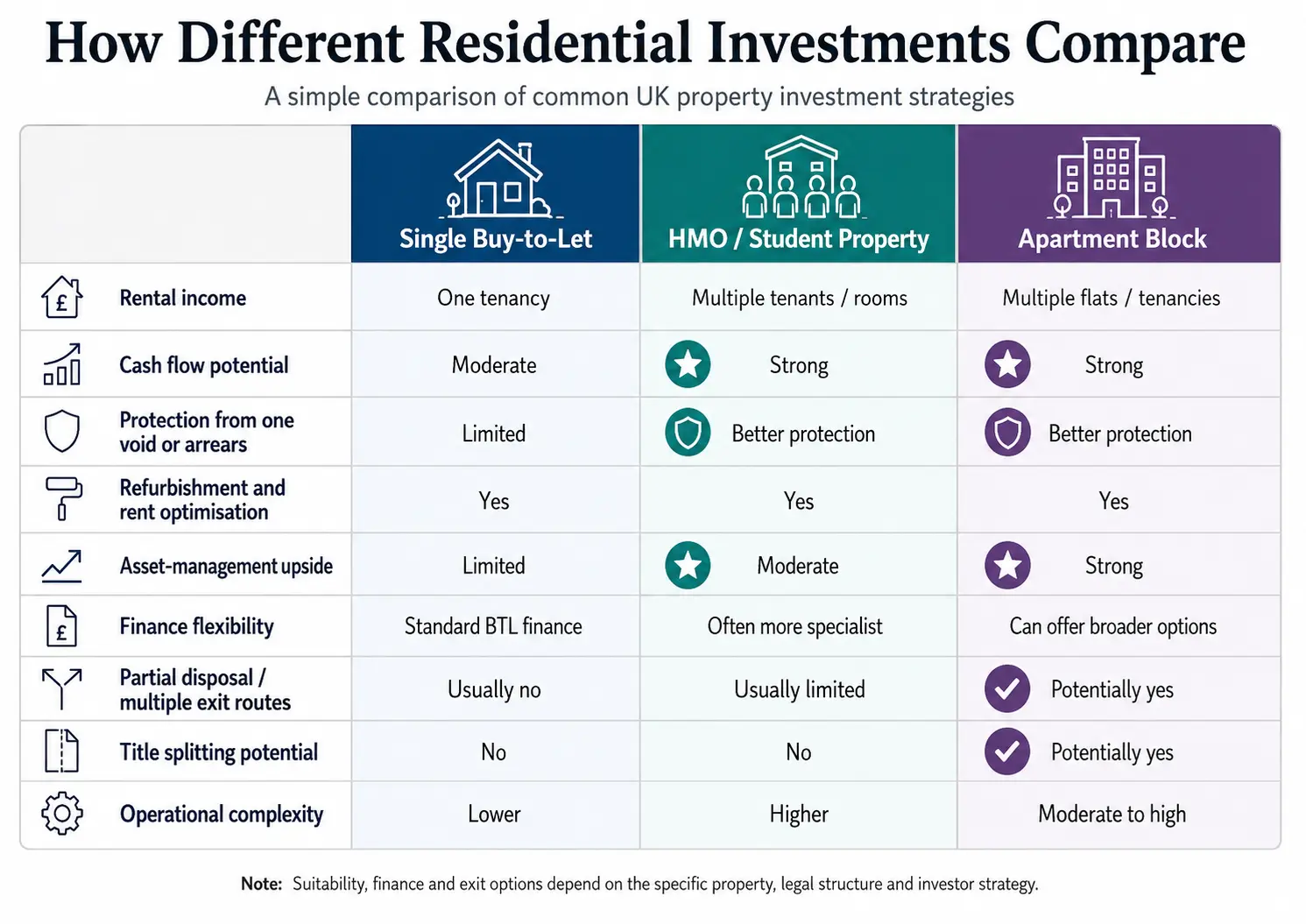
As the comparison shows, there are legitimate reasons investors choose each strategy.
What makes apartment blocks particularly interesting is not simply that they produce rent from several flats. HMOs and many student investments already provide the benefit of multiple rental streams and potentially strong cash flow.
The distinction is that a suitable block can sometimes combine those benefits with additional asset-level options.
There may be opportunities to improve several units, optimise the performance of the whole building, refinance, sell as one investment or, where appropriate, create separate titles and dispose of individual flats.
That additional flexibility is one reason more experienced investors often begin considering blocks as their portfolios grow.
Investors wanting to see what these opportunities look like in practice can browse current apartment blocks for sale across the UK through BlockLand.
So, What Makes a Good Property Investment?
There is no single calculation that can tell you whether a property is a good investment.
Yield matters, but it should form part of a much wider appraisal.
Strong investments tend to combine genuine tenant demand, sustainable cash flow, sensible financing, manageable downside and realistic opportunities to add value.
They should also have a clear exit.
For some investors, a straightforward buy-to-let will tick those boxes perfectly. For others, an HMO or student property may provide the stronger income they are looking for.
And for investors who want multiple income streams combined with a wider range of value-add and exit opportunities, apartment blocks can be well worth considering.
Ultimately, before asking only:
“What yield does it produce?”
it may be worth asking:
“How many different ways can this investment work for me?”